
Transcript
Announcer:
Welcome to CME on ReachMD. This activity is provided byTotal CME, LLC. This episode is part of our MinuteCE curriculum.
Prior to beginning the activity, please be sure to review the faculty and commercial support disclosure statements as well as the learning objectives.
Dr. DuBrock:
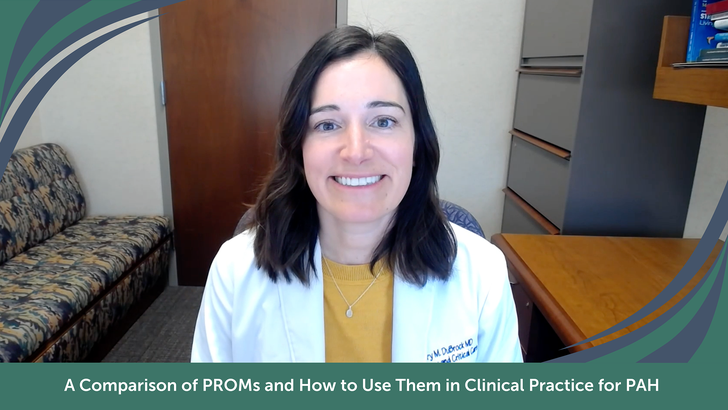
This is CME on ReachMD and I'm Dr. Hilary DuBrock. As discussed in Episode 5, a PROM, or patient-reported outcome measure, is any measurement of a patient's health status directly elicited from the patient. PROMs generally assess the impact of pulmonary hypertension on an individual's health-related quality of life. PROMs are questionnaires typically developed with patient input to identify the concepts and domains that are most important to patients. A PROM should measure these concepts and are important to patients and be reliable and validated in the intended population for use.
We have several generic and disease-specific patient-reported outcome measures available for use in both research and clinical practice. Generic PROMs include questionnaires such as SF-36 or the shorter version, SF-12, which both have mental and physical component summary scores. These are probably the most commonly used generic PROMs, but for the purposes of this discussion today, we're going to focus primarily on the pulmonary hypertension disease-specific PROMs that have been evaluated and studied primarily in pulmonary arterial hypertension.
First off, CAMPHOR is a PAH disease-specific validated PROM that's been around the longest. It assesses symptoms, function, and quality of life. It has 65 questions, so it's rather lengthy and thus difficult to incorporate into routine clinical visits, but it's reasonable to use in a research setting and has been the most extensively studied in that way.
EmPHasis-10 is a short, validated, and easily administered questionnaire that is PAH disease-specific and freely available for academic and clinical use. It has just 10 questions, as implied by the name, and thus it's pretty easy to add to clinic visits since it doesn't take up much time. Importantly, EmPHasis-10 can also be used in a research setting since it's convenient for patients and there's an established minimal clinically important difference.
The Living with Pulmonary Hypertension Questionnaire was adapted from the Minnesota Living with Heart Failure Questionnaire to be PAH disease-specific and includes 21 questions summarized into emotional, physical, and total scores and also has been used in some studies.
PAH-SYMPACT is the newest PROM kid on the block that was developed and validated in accordance with FDA guidelines. Notably, it's sensitive to change and includes 23 questions from 4 total domains: cardiovascular symptoms, cardiopulmonary symptoms, physical impact, and cognitive and emotional impact.
It was originally developed as a tool to be administered for 7 consecutive days, but a subsequent study found that 1-day scores were actually highly correlated with 7-day scores and was also sensitive to change, so this abridged version is more feasible for routine use.
PAH-SYMPACT is appropriate for both the clinical setting and the research setting, although there's no well-established minimal clinically important difference and it may require some licensing fees for use.
Importantly, New York Heart Association Functional Class, for example, is not a PROM. It's not directly elicited from the patient, but it's a clinician-rated assessment used to assess the impact of pulmonary hypertension on an individual's physical activity. PH Functional Class Self-Report, or PH-FC-SR, is a PROM that was developed as a patient-reported version of functional class to better understand the patient perspective and to facilitate remote reporting of functional class in times of telemedicine and remote clinical trials.
PROMs are important and often underutilized clinical endpoints in clinical trials, where findings measured by a well-defined and validated PROM can be used to support a therapeutic claim in a label. For example, in STELLAR, a phase 3 multicenter, randomized control trial of sotatercept versus placebo in patients with pulmonary arterial hypertension, sotatercept was associated with improvements in health-related quality of life in 2 out of 3 of the PAH-SYMPACT domains studied.
PROMs are important clinical trial endpoints because they measure what matters to the patients. The downside is that the medications may not address all of the multidimensional aspects of the disease assessed in a PROM, such as the cognitive and emotional impact, which notably was not significantly improved with sotatercept in the STELLAR study.
So how do you pick which one to use? Well, it depends on things like time, licensing, and the overall goals of your assessment and using your PROM, whether you're using it in research or in clinical practice. In clinical practice, PAH-SYMPACT and EmPHasis-10 are probably the easiest to incorporate since they're validated and relatively short, which minimizes the burden on patients. Similarly, EmPHasis-10, PAH-SYMPACT, or CAMPHOR are all reasonable to use in a clinical trial setting.
In conclusion, we're fortunate to have several pulmonary hypertension disease-specific PROMs which help us to systematically assess the patient perspective and quality of life in our patients with pulmonary arterial hypertension. Now, we just need to use them more routinely in clinical practice as well as in clinical trials.
Thank you for your attention and thanks for tuning in. I hope this information will be useful in your clinical practice.
Announcer:
You have been listening to CME on ReachMD. This activity is provided by Total CME, LLC and is part of our MinuteCE curriculum.
To receive your free CME credit, or to download this activity, go to ReachMD.com/CME. Thank you for listening.