
Transcript
Announcer:
Welcome to CE on ReachMD. This activity is provided by TotalCME. This episode is part of our MinuteCE curriculum.
Prior to beginning the activity, please be sure to review the faculty and commercial support disclosure statements as well as the learning objectives.
Dr. Issa:
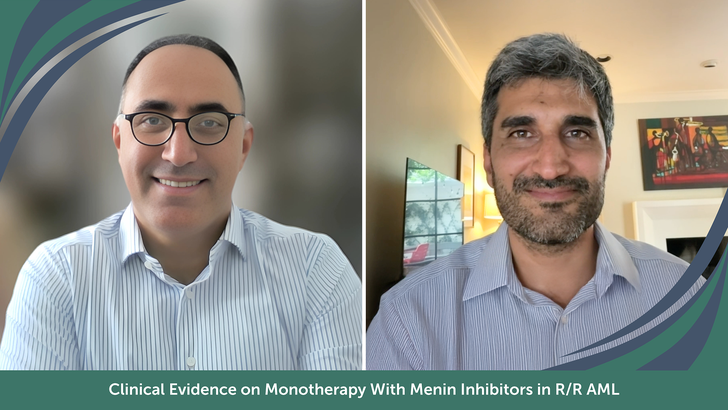
This is CME on ReachMD, and I'm Dr. Ghayas Issa. In this brief lecture, I will review the clinical results with menin inhibitor monotherapy. And a lot of these results have been updated at the last European Hematology Association meeting.
So I'll take you first, through the data from the AUGMENT-101 trial. This is the trial that led to the approval of the menin inhibitor, revumenib, for KMT2A-rearranged acute leukemia. These results were based on a single-arm study of any relapsed/refractory patient that had KMT2A-rearranged leukemias, and it included infants, children, and adults. The overall response rate was roughly about 60%, with the CR/CRh rate roughly about 25%. We've had updated analysis presented by my colleague, Dr. Aldoss, showing robustness of this data beyond the interim analysis that led to the FDA approval of revumenib.
And more recently, we've had the second arm of AUGMENT-101, which was specifically for NPM1-mutant acute myeloid leukemia, published in the journal of Blood with the first author, Dr. Arellano. And an update presented at the last EHA meeting showing, again, responses in NPM1-mutant acute myeloid leukemia. In this cohort of patients, the overall response rate was 48% with the CR/CRh rate of 26%. Again, this is showing promising results, which is leading to all the supplementary NDA submission for revumenib for NPM1-mutant acute leukemias.
We also presented at EHA results of the menin inhibitor, revumenib, in NUP98-rearranged acute leukemias. So in this presentation, we show that the menin inhibitor, revumenib, as predicted in preclinical models, leads to these responses in a small number of patients that we've presented with NUP98-rearranged leukemias. So 3 out of 5 patients that we've tested attained a response.
The menin inhibitor, ziftomenib, has been focused on NPM1-mutant acute myeloid leukemia as a single agent following dose escalation, and the results of the phase 1 and phase 2 pivotal study were presented by my colleague, Dr. Eunice Wang, at the ASCO meeting. The treatment with ziftomenib led to an overall response rate roughly between 40 and 50% with a CR/CRh rate roughly around 25%. And both the median duration of response in NPM1 for revumenib and ziftomenib were roughly around 4 months.
These results have warranted submissions for approval for the menin inhibitor, ziftomenib, and with an expected PDUFA date in November by the FDA.
Now the menin inhibitors, bleximenib and enzomenib, are showing similarly encouraging results. The menin inhibitor, bleximenib, data were presented by Dr. Searle at ASH. It led to similar overall response rate, roughly about 40%, for KMT2A-rearranged leukemias or NPM1-mutant leukemias. Similarly, for the menin inhibitor, enzomenib, which was also investigated in dose escalation, and the data for the efficacious dose show promising results with a similar response rate to the other menin inhibitors for KMT2A-rearranged leukemias or NPM1-mutant acute myeloid leukemias.
So these results are very promising. It shows that, overall in this class, there's excellent efficacy. Especially for NPM1-mutant acute myeloid leukemia, the results seem similar.
The next steps are to incorporate these therapies in standard of care. One of the promising aspects is to try to intercept relapse by intervening at the time of measurable residual disease, or MRD. There's the INTERCEPT study by Dr. Wei that is testing the menin inhibitor, revumenib, for MRD-positive NPM1-mutated or KMT2A-rearranged leukemias and trying to eradicate MRD and prevent relapse.
Well, my time is up. I hope I've given you something to think about. Thanks so much for listening.
Announcer:
You have been listening to CE on ReachMD. This activity is provided by TotalCME and is part of our MinuteCE curriculum.
To receive your free CE credit, or to download this activity, go to ReachMD.com/CME. Thank you for listening.