
Transcript
Announcer:
Welcome to CE on ReachMD. This activity is provided by TotalCME. This episode is part of our MinuteCE curriculum.
Prior to beginning the activity, please be sure to review the faculty and commercial support disclosure statements as well as the learning objectives.
Dr. Issa:
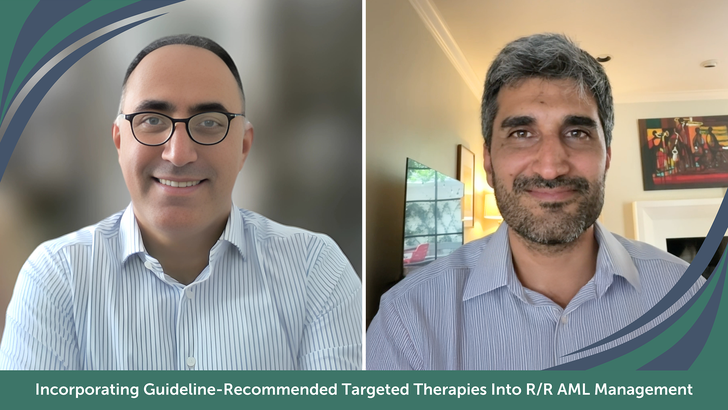
This is CME on ReachMD, and I'm Dr. Ghayas Issa.
Dr. Fathi:
And I'm Dr. Amir Fathi.
Dr. Issa:
Dr. Fathi, can you provide an overview of current guidelines on using targeted therapies for relapsed and refractory AML?
Dr. Fathi:
Per the pitch, in terms of diagnostics, particularly when it comes to relapsed or refractory patients, it’s a combination of mutational, chromosomal, and microscopic evaluation of patients with AML. These are sort of our standard approaches. When it comes to mutational testing, we do have an institutional NGS panel, which incorporates certain mutations that are thought to be potentially important for the purposes of targeted therapies. This rapid NGS comes back within 2 to 3 days. We then have a more broad NGS panel that captures more myeloid mutations and alterations, as well as a fusion panel that picks up important fusions.
In terms of the therapies that then emerge for patients with relapsed or refractory AML that potentially can be targeted at these specific alterations, those would include IDH inhibitors, or IDH1, for example. Those who have IDH1 mutations, we have ivosidenib and olutasidenib in the relapsed refractory setting. For IDH2 mutations, we have enasidenib in the relapsed refractory setting. For FLT3 mutations, we have gilteritinib. And relevant to the discussion today, for patients who have KMT2A-altered disease, oftentimes picked up either on cytogenetics or chromosomal testing, or on fusion testing, we have the menin inhibitor, revumenib.
So, I think it is very important to have NGS, or any type of mutational testing that helps pick up these alterations, because they're relevant for targeted therapy.
Dr. Issa, how would you incorporate guidelines on targeted therapies into the clinical decision-making process?
Dr. Issa:
So as you mentioned, genomic testing is critical to make appropriate clinical decisions in the management of AML, either frontline or relapsed/refractory disease. And it's important to note that those mutations that we track could be dynamic. For example, sometimes with relapsed, there could be an acquisition of a FLT3 mutation that would change management where a FLT3 inhibitor is added. So I would recommend retesting, including genomic analysis at relapse in order to match with the right targeted therapy. So in this case, it would be FLT3 inhibitors. In the case of relapsed/refractory disease, the FLT3 inhibitor, gilteritinib, or in case of IDH mutations, or now with the availability of menin inhibitors, specifically revumenib, for KMT2A-rearranged leukemias. The menin inhibitor, revumenib, has received FDA approval in relapsed/refractory KMT2A-rearranged leukemias and is currently included in the guidelines as a recommended treatment for these patients. And hopefully in the near future, for NPM1-mutated acute leukemias, revumenib, or the menin inhibitor, ziftomenib, that are currently submitted for FDA approval.
Dr. Fathi:
I tend to agree with you Ghayas, everything that you said. In fact, as I'm sure you have had, we've had multiple patients over the course of the last several years who have had mutations emerge on disease progression or relapse that allow them to have another option for effective targeted therapy. Or the most common mutation that we see emerge with disease progression or relapse is FLT3 mutations. And we have had several patients with FLT3 mutations emerging at relapse, that helps us provide targeted therapies for those patients. The opposite is also true. FLT3 mutations can disappear also, on relapse, and a patient that may have been vulnerable to FLT3 inhibitor therapy, may no longer be susceptible to it on relapse. So it's very important, as you said, to check these alterations at important points of the patient’s disease course.
Dr. Issa:
Well, this has been a great discussion. Our time is up. Thanks for listening.
Announcer:
You have been listening to CE on ReachMD. This activity is provided by TotalCME and is part of our MinuteCE curriculum.
To receive your free CE credit, or to download this activity, go to ReachMD.com/CME. Thank you for listening.