
Transcript
Announcer:
Welcome to CME on ReachMD. This activity is provided by Total CME, LLC. This episode is part of our MinuteCE curriculum.
Prior to beginning the activity, please be sure to review the faculty and commercial support disclosure statements as well as the learning objectives.
Dr. Kingman:
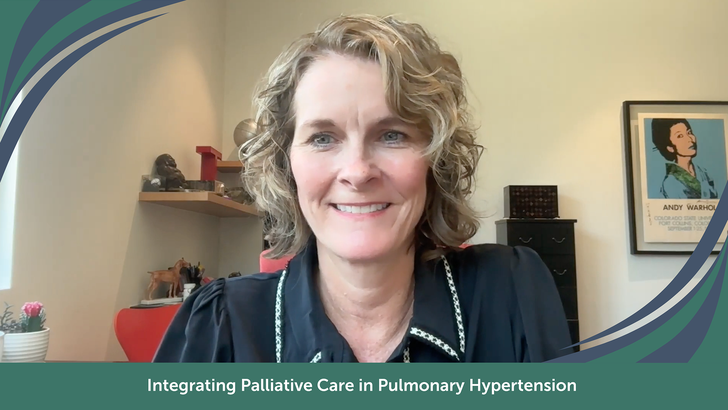
Hello. This is a CME program on ReachMD, and I'm Martha Kingman, and today I'm going to talk to you about palliative care and how it can help our patients with pulmonary arterial hypertension.
Palliative care is not just end-of-life care, and sometimes patients think that, “Oh, this is the end, we’re putting them on hospice,” but actually, palliative care can be initiated at any point through a chronic illness and can be very helpful for patients in a number of ways. It can help them with symptom management. It can improve quality of life. And also, it's really helpful for them to be enrolled in palliative care because the palliative care team will help them talk about and think through some decisions for long-term care planning and so on.
So palliative care, again, is not the same as hospice, and this is a very common misconception among patients and causes them to hesitate when we talk to them about palliative care. So I always really make the point to say, “This isn't hospice. This doesn't mean that we're not taking care of you anymore. This is an adjunct to your therapy session or your therapy plan. It's really helpful for all patients who have serious chronic illnesses.”
The palliative care team consists of doctors, nurses, social workers, and other specialists that can help patients with symptom management, and certainly our patients have a high symptom burden. It can help in many ways with their emotional support and provide that advanced care planning that’s really important for patients to have on board and for their family members to understand what their wishes are over time as this disease progresses.
As far as symptoms, we all know shortness of breath is very common in pulmonary arterial hypertension, as is fatigue, sometimes swelling, body aches. Sometimes medication side effects cause some discomfort. These are areas where palliative care can be very helpful. Their focus is on symptom management.
The emotional and psychological support that patients can get in palliative care is also very important. We know that about half of the patients with PAH have some sort of issue with either depression and/or anxiety. Sometimes in clinic, we are so busy that we don't take the time really to focus on emotional needs or psychological needs, so that's one area where palliative care can be very helpful.
Also, the family members and the caregivers can benefit from palliative care, and we tell patients to be sure to bring your spouse or your caregiver or whoever your person is that provides support to you, because they can also get support from palliative care and learn ways to better support the patient.
When do we tell patients or talk to patients about palliative care? In my experience, what we would do is, certainly those patients who are having a lot of symptoms, we would talk about palliative care. In our practice, we would generally – if someone was going to go on IV therapy or subcutaneous therapy, that indicated that they're more advanced in the disease process. So that would be our trigger to think about if they're going to go on IV therapy, this is a time also to have a talk about palliative care, if we haven't done so already. But really, it can be integrated into any stage of pulmonary arterial hypertension.
Key takeaways from today's brief lecture. The first one, which is very important, is to make sure that your patients understand that palliative care is not hospice. It does not mean this is the end of their life or that we're giving up on them.
The other point is that palliative care can be initiated at any time. If you have a patient who tends to have a lot of symptoms and a lot of trouble managing them or needs a lot of emotional support, think about those patients being referred early. It's never too early to refer to palliative care. But for sure, by the time you have patients that are on parenteral therapy, you're doing them a good service to talk to them and put that referral in. This is just another layer of support for the patients.
I hope that this has been informative and that it will be useful in your practice. Thank you so much for attending today.
Announcer:
You have been listening to CME on ReachMD. This activity is provided by Total CME, LLC and is part of our MinuteCE curriculum.
To receive your free CME credit, or to download this activity, go to ReachMD.com/CME. Thank you for listening.