
Transcript
Announcer:
Welcome to CE on ReachMD. This activity is provided by TotalCME. This episode is part of our MinuteCE curriculum.
Prior to beginning the activity, please be sure to review the faculty and commercial support disclosure statements as well as the learning objectives.
Dr. Fathi:
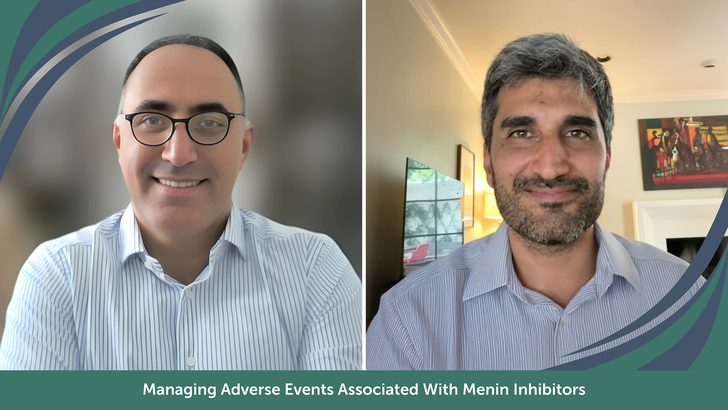
Hello. This is CME on ReachMD, and I'm Dr. Amir Fathi.
Dr. Issa:
And I'm Ghayas Issa.
Dr. Fathi:
Dr. Issa, what are some of the common toxicities associated with menin inhibitors?
Dr. Issa:
So the ones I would consider as on-target or class effect would be differentiation syndrome and possibly effect on counts or myelosuppression or cytopenia. And then there are some toxicities that are specific to each menin inhibitor. So for example, QT prolongation, for revumenib, or itching for ziftomenib. Overall, these medicines are very well tolerated compared to chemotherapy and similar to other targeted therapies we've had for acute myeloid leukemia.
Dr. Fathi, how would you monitor and manage these adverse events?
Dr. Fathi:
Thank you. I think probably the most prominent and challenging adverse event that can arise in the setting of menin inhibitor use is differentiation syndrome, and it can be quite severe in a minority of patients. As a result, I think it is important to recognize the entity or the potential for the entity early on. And that can be challenging, because the manifestations of the differentiation syndrome can be quite pleomorphic and vague. Fevers and pleural effusions and lung infiltrates and rising white blood cell count, a lot of this can be seen with the leukemia itself, with infections, with cardiopulmonary manifestations, but if you suspect it, you should manage it. And generally, the first-line treatment is steroids, and oftentimes hydroxyurea or other cytoreductive measures to decrease the potential white blood cell count elevation and risk of hyperleukocytosis.
QT prolongation is typically associated with the use of revumenib and has been noted in clinical trials. There is guidance in the prescription sheet document about how to manage QT interval prolongation and how to monitor for it closely. Suffice it to say, a baseline EKG is very important, and then close monitoring of EKG thereafter, with dose reduction or delays as needed.
Although I have not seen much in terms of GI toxicity with menin inhibitors, nausea has been reported so appropriate antiemetic use is recommended. Cytopenias have also been uncommonly seen with menin inhibitors, so supportive care management transfusions might be needed in certain scenarios, and on rare occasion, pausing of the drug or dose adjust.
Dr. Issa:
Yeah, this is an excellent summary. I would just emphasize the importance of recognizing differentiation syndrome and early start of steroids. So just having a high index of suspicion when someone starts on a menin inhibitor, so because differentiation syndrome tends to happen within the first 1 to 2 months, and steroids can be lifesaving in this case.
Dr. Fathi:
Thank you, Dr. Issa. I completely agree with you. Differentiation syndrome with menin inhibitors, at least in my experience, seems to occur on several occasions earlier than what you would potentially see with other targeted inhibitors. So it's important to keep your antennas up right from the beginning, within the first week or two, for the potential of differentiation syndrome and then quick management of it if there is suspicion for it.
Well, this has been a great, bite-sized discussion. Our time is up. Thank you so much for listening.
Announcer:
You have been listening to CE on ReachMD. This activity is provided by TotalCME and is part of our MinuteCE curriculum.
To receive your free CE credit, or to download this activity, go to ReachMD.com/CME. Thank you for listening.