
Transcript
Announcer:
Welcome to CE on ReachMD. This activity is provided by TotalCME. This episode is part of our MinuteCE curriculum.
Prior to beginning the activity, please be sure to review the faculty and commercial support disclosure statements as well as the learning objectives.
Dr. Issa:
This is CME on ReachMD, and I'm Dr. Ghayas Issa.
Dr. Fathi:
And I’m Dr. Amir Fathi.
Dr. Issa:
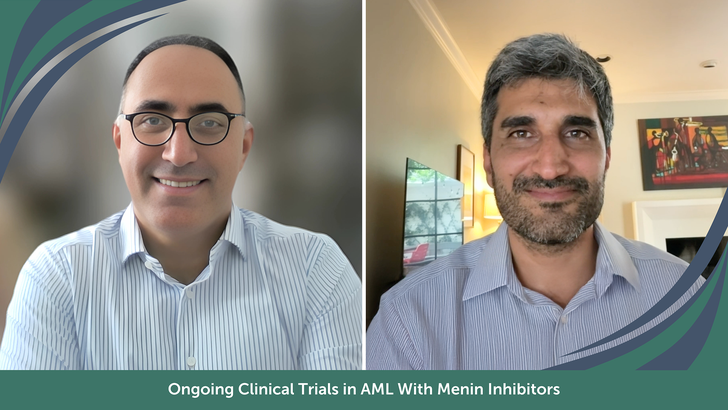
Dr. Fathi, can you provide an overview of clinical trials with menin inhibitors in AML, and which ones are currently accruing patients?
Dr. Fathi:
Yeah, no, this is an exciting time, and there are a large number of menin inhibitors that are currently in clinical trials and under investigation, both in the relapsed and refractory setting as well as the newly diagnosed setting in which the menin inhibitors are being combined with upfront standard therapies.
In terms of relapsed/refractory disease, I would say that this is the clinical trial portfolio that is probably the most expansive, given that it's been around for some time. The menin inhibitors that are furthest along in investigation and have had multiple publications associated with them are revumenib and ziftomenib. However, bleximenib and enzomenib are not too far behind, and there has been promising data presented at national meetings and global meetings on promising response rates and remission rates with those agents as well.
In the newly diagnosed setting, all of these drugs are very likely going to be studied in combination with upfront strategies. Revumenib and ziftomenib, as well as bleximenib, have been studied in combination with intensive therapies as well as hypomethylating agents, so venetoclax, those trials, many of them are still ongoing. There are also plans, as we know, for a phase 3 randomized study for several of these menin inhibitors.
Dr. Issa, how would you incorporate trial opportunities into practice for patients?
Dr. Issa:
Yeah, that's a great question. And it's a little bit of research that I’m doing currently, and I hope to publish soon, and it's related to the outcomes on clinical trials. For patients that are with relapsed/refractory AML, we simply don't have a good standard of care. All the medicines that we use are suboptimal. So we looked at our institution, for example, on outcomes of patients that enroll on clinical trials, those that had second-line and beyond treatment versus giving them chemotherapy. And the ones that go on clinical trials do better and have less toxicity. So given that this is the way we change the future and we get new management, and also it's in the best interest of patients to get on clinical trial. In my practice, that's my top recommendation for patients who have relapsed/refractory disease, especially.
Now, whenever we use them in front line, we try to do better than what we have currently. And that's all the combination studies that Dr. Fathi just mentioned. So for example, a randomized study of high-intensity chemo plus or minus menin inhibitor is very important. It has a high chance, in my opinion, of changing standard of care. And we have excellent science that supports these trials.
So for all these reasons, I think enrolling on a clinical trial should be a priority, and referring patients to centers that have clinical trials is in the best interest of patients.
Maybe a little comment on barriers to enroll in clinical trials. To me, it's related to some perception that there could be good treatments for AML that the patient would be missing on. And that's, unfortunately, not the reality. Once they receive high-intensity chemo, chances of response are really low.
Amir, or do you have any other points you would like to highlight?
Dr. Fathi:
I think you've highlighted the biggest ones. We experience this also in Boston. I think one aspect of that that I think you probably are also dealing with as a very large cancer center that probably addresses, takes care of patients in a wide geographic area, is distance. So for us, it’s sometimes difficult for patients to sort of present for clinical trials that require multiple visits and assessments. So that is something that we are trying to overcome by providing them housing and local capability so that they can participate in very important clinical trials, as you said.
Dr. Issa:
Right. And that's the great advantage of pills in clinical trials; that we've seen that too, where sometimes we can incorporate virtual visits later. When they have pills, you can see them, do the assessment for clinical trials, and they go home and take those medicines.
Well, this has been a brief but great discussion. I hope we gave you something to think about, and thanks again for tuning in.
Announcer:
You have been listening to CE on ReachMD. This activity is provided by TotalCME and is part of our MinuteCE curriculum.
tivity, go to ReachMD.com/CME. Thank you for listening.