
Transcript
Announcer:
Welcome to CME on ReachMD. This activity is provided by Total CME, LLC. This episode is part of our MinuteCE curriculum.
Prior to beginning the activity, please be sure to review the faculty and commercial support disclosure statements as well as the learning objectives.
Dr. Ford:
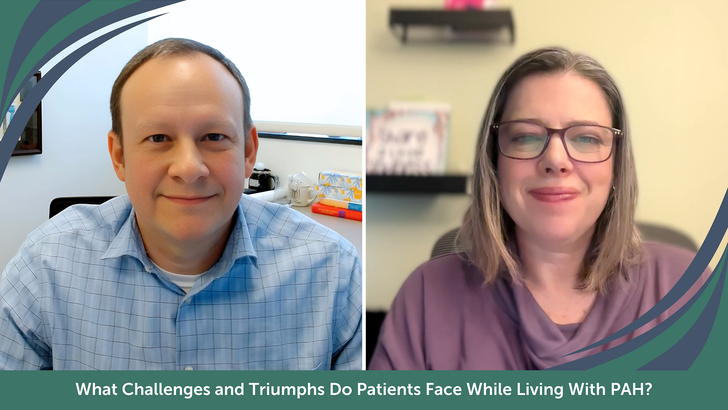
This is CME on ReachMD. I'm Dr. Jimmy Ford. Here with me today is Colleen, a patient who is living with PAH.
PAH can be an extremely stressful diagnosis, and how patients take care of themselves—including outside of the clinical interactions with their providers—is important to know about.
Colleen, can you tell us a little bit about how your goals for your personal life drive your decisions and maybe share some important aspects of the PAH journey for patients that clinicians should be aware of?
Colleen:
Sure. Hello, and thank you so much for these questions. To begin, it is important to understand that being a PAH patient is so much more than intermittent clinic visits, readouts of tests, and day-to-day management of medications. Treating the PAH patient is really about treating the whole person, and our lives are complicated. Managing PAH can feel like a full-time job. For instance, I currently take 7 different doses of medication a day—3 times a day with pills, 4 times a day inhaled—and then I add 1 more treatment every 3 weeks. In between that, I'm managing side effects, time-consuming specialty pharmacy orders, multiple doctors’ appointments for associated issues and routine care, billing issues, and more. And that's all before I turn my attention to being a wife, a mother, a daughter, a sister, a friend, an advocate, an entrepreneur. Those things are how I identify, not just as a sick person. And those pieces of my identity have had to shift and reshape based on my diagnosis and life with PAH.
Being a PAH patient requires a holistic system of support. So what can that look like? Well, first I want to talk a little bit about adaptive strategies. In this case, we want to look at not only what can or can't be done with physical limitations—such as household chores or a current job—but also things that the patient enjoys. For instance, I was a classically trained ballerina. I danced my whole life. After my diagnosis, I couldn't do that anymore. I was losing not only my preferred form of exercise but a thing that made me really happy, and I had to adapt. With the help of my PAH specialist, I had to find exercise I could still safely do. And in my personal life, remind myself I could still enjoy performances of the art I loved, even if I couldn't join in.
Peer support is another vital component of PAH care. I wouldn't have made it those first 6 months without other patients holding me up and showing me the way. Now I've learned that in giving back and helping others in the same way, it has given my life new meaning.
And I would be remiss if I didn't touch on a few more traditional modes of patient support, such as palliative care. There remains a great deal of confusion around what palliative care is, and it's important to broach the topic with patients really carefully, making clear that it is not about end-of-life decisions but rather about living life with as much ease as possible. So patients may benefit from support around insurance advocacy, pain management, nutrition education and planning, and emotional and spiritual support.
Life with PAH is hard—there's no doubt about it—but the effort to support the whole patient can pay off in spades. Building resilience and supporting the patient not only with PAH, but in living their life around PAH.
I know this to be true because when I was first diagnosed, my son was about 18 months old. I really did not think I would live to see him reach kindergarten, and last year I saw him graduate from high school. I was also told we would never have more children, and my heart was broken. Ten years ago, we adopted a baby girl, and she is a thriving fourth grader. My treatments have come so far that I can dance again. I've found new hobbies and even a new career that works around my illness, too. So my life is full and meaningful.
These victories are what I want every PAH patient to get to experience, whatever that looks like for them. They can only come when we treat the whole patient and empower them to chase what matters most to them.
Thank you.
Dr. Ford:
That's great. Thank you, Colleen, for sharing those tremendous insights and your perspective and your journey with us. I hope it's been info
Announcer:
You have been listening to CME on ReachMD. This activity is provided by Total CME, LLC and is part of our MinuteCE curriculum.
To receive your free CME credit, or to download this activity, go to ReachMD.com/CME. Thank you for listening.