
Transcript
Announcer:
Welcome to CME on ReachMD. This activity is provided by Total CME, LLC. This episode is part of our MinuteCE curriculum.
Prior to beginning the activity, please be sure to review the faculty and commercial support disclosure statements as well as the learning objectives.
Dr. Elwing:
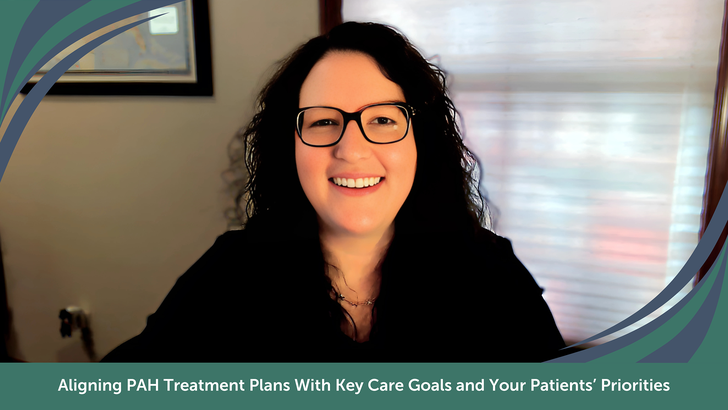
This is CME on ReachMD, and I'm Dr. Jean Elwing.
In PAH, our clinical targets are clear: improving hemodynamics, functional status, and risk stratification. But those goals are only part of the equation. For each patient, we also need to consider what they hope to achieve. Patients always come to us with a lot of questions. They often come newly diagnosed, scared, and unsure of what this disease means to them and their families. Their understanding may be limited. Their goals might be focused on very human, daily life things, like: Will I be able to walk my dog again? Can I go back to work? Will I be around for my kids? Will I ever see my grandchildren? These are real and very impactful.
It's our job as providers to hold both sets of goals—the measurable clinical ones and the deeply personal ones—and try to achieve them both. Sometimes, they're not perfectly aligned. That patient may want to stay on oral therapy, for example, when we see the need to escalate to parenteral therapy. The key is to openly communicate and find ways to make these goals work in concert. Sometimes, however, the provider and patient goals remain divergent. If that's the case, we need to name it, we need to discuss it, and this dialogue is what makes patient care truly patient centered.
Let's talk a little bit more about shared decision-making. It's more than just offering options A, B, or C. It's about hearing and really listening to what the patient says, and perhaps what they don’t say. What are they fearing? What are their preferences? Are they willing to accept the complexities of the recommended therapy if it means longer-term benefits? And truly, is their lifestyle or their home situation aligned with certain treatments over others?
And let's not forget the other members of their care team—the care partners, family, spouses, close friends, those who are in the room when you see the patient or just outside of it. Sometimes they pick up on things we miss. Including them, when appropriate, helps us anchor care plans in real-life support.
We also have to think about what happens when the patient leaves our examination room. They are not in a bubble. Do they really understand their disease? Are they equipped to follow through? We need to educate and understand and teach at whatever level that person needs. Education is empowering, but so is reassurance. Sometimes we need to verbalize, "You are not alone. We are in this together, and we are here to support you and what you need." And sometimes we need to add, "We won't ask you to do anything we don't know and think you can do."
We can also empower patients by giving them the tools to track symptoms, manage medications, and recognize warning signs and, equally important, help them to advocate for themselves in this complex healthcare system.
If there are 3 words to carry forward from this episode, they are: understand, communicate, and empower. When we understand our patient goals, communicate openly, and empower them to take an active role in their care, we create treatment plans that truly align with what matters most—an effective PAH treatment plan built with, not just for, our patients. Aligning clinical priorities with their values ensures more engaged care, better adherence, and, ultimately, improved outcomes.
Thank you for joining us today. I hope this episode has given you something to reflect on when caring for your patients. I'm Jean Elwing, and thanks for tuning in to ReachMD.
Announcer:
You have been listening to CME on ReachMD. This activity is provided by Total CME, LLC and is part of our MinuteCE curriculum.
To receive your free CME credit, or to download this activity, go to ReachMD.com/CME. Thank you for listening.